

(Michael Vick & Norfolk State Football)
Leaders aren’t expected to practice. They are expected to arrive ready to perform.
- School principals & superintendents.
- College coaches & University Administrators.
- Executive directors & CEOs.
Across sectors, leadership expectations are remarkably similar: step in, stabilize quickly, and produce results.
Whether the role is new or long-held, leaders are expected to perform at game speed, with very little time devoted to practice.
Even when leaders are not transitioning into new positions, the teams around them are constantly changing.
Today’s workforce is more mobile, less loyal to institutions, and more transient by necessity and design. In college athletics, coaches may return season after season to an entirely different roster due to the transfer portal. The expectation, however, remains the same: lead as if nothing has changed.
This reality makes the absence of leadership “practice” even more costly.
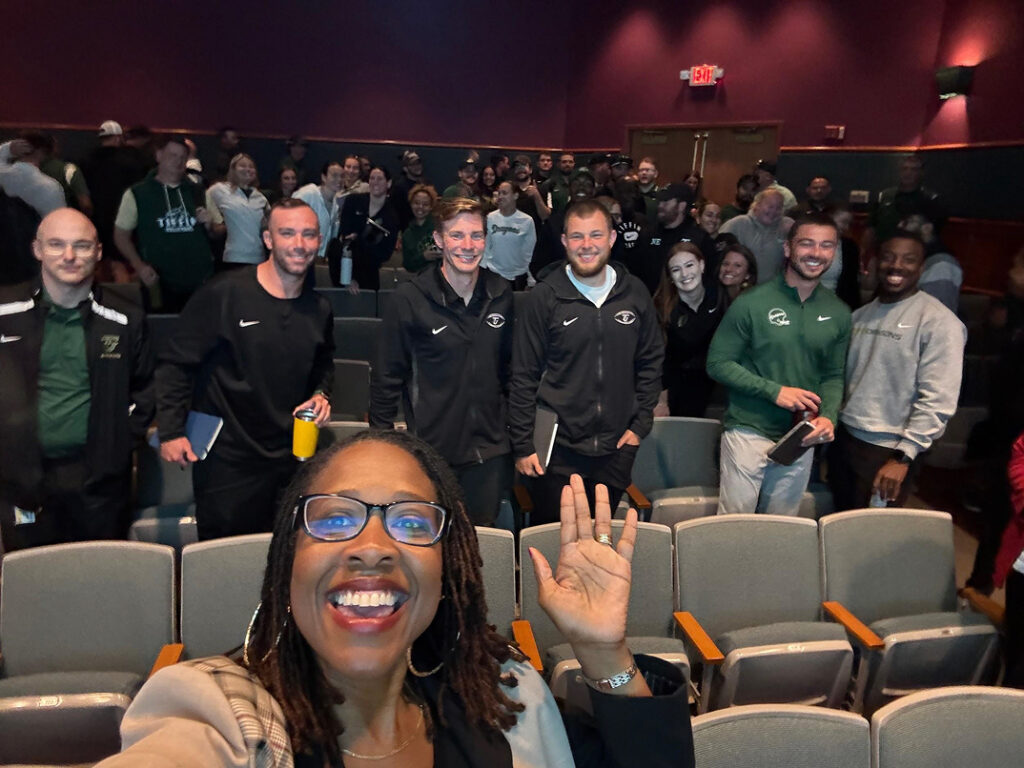
Three reasons why practicing leadership, not just performing it, is essential.
1. Skill development requires live feedback, not private repetition
Popular leadership author Kim Scott, in Radical Candor, emphasizes that growth happens through timely, direct, and caring feedback, not after-the-fact evaluation. Leaders, like athletes, need real-time coaching to identify blind spots, correct habits, and refine strategy. Annual reviews and outcome metrics alone do not build skill; they simply score outcomes.
2. Teams change faster than leadership skill sets can adapt without practice
Leadership is relational. When employees, athletes, or stakeholders change, leaders must recalibrate communication, trust, expectations, and influence. Yet leaders are rarely given time to assess the new landscape, understand cultural dynamics, or build rapport before being evaluated on outcomes. Without space to practice these relational adjustments, leaders default to old strategies that may not align with the team in front of them.
3. Performance-only cultures suppress time for learning and strategic risk-taking
Adam Grant’s research on learning cultures shows that environments focused solely on results discourage experimentation and honest reflection. Leaders operating under constant evaluation are more likely to protect themselves than to adapt. Amy Edmondson’s work on psychological safety reinforces this: when mistakes are punished rather than examined, leaders avoid calculated risks and practicing new strategies; the very risks required for innovation, culture-building, and long-term performance.
This principle is well understood in sports.
Nothing frustrates a college coach more than an athlete who logs endless hours of practicing bad habits. A player who trains alone, avoids playing against others, and never goes at game speed may appear disciplined and strategic, but without game-like conditions and live correction, they often reinforce bad habits. Repetition without LIVE feedback is a long journey toward improvement.
Leadership works the same way. At Agility Counseling Group, we intentionally create space for leaders to practice.
Through our Executive Therapy Coaching (ETC) services, leaders are given structured, psychologically safe environments to test skills, receive live feedback, refine strategies, and strengthen relational effectiveness without the fear of being penalized for learning. This is where leadership habits are shaped before they show up in high-stakes moments.